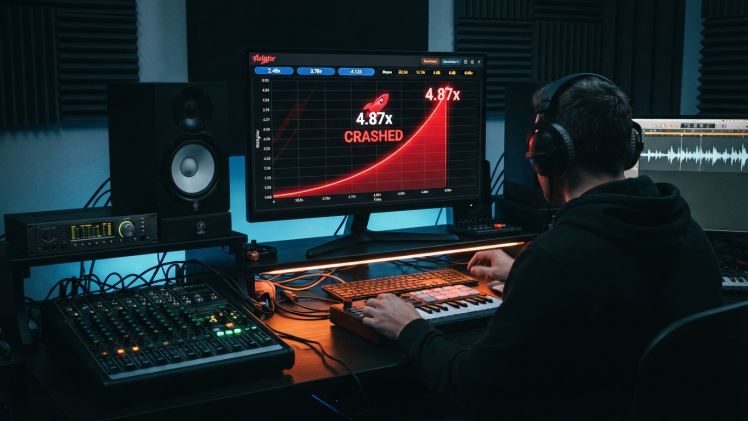
Composers writing for a crash game face a problem no film score encounters: the music must build tension toward a climax whose timing is genuinely unknown, every round, forever. There is no edit to cut to, no fixed duration, no way to plan the crescendo. Opening a JetX game link starts an audio system that has to improvise within strict rules, and the techniques behind it come from interactive music rather than traditional scoring.
The Structural Problem
A round can end at any moment. A linear piece of music therefore either finishes before the round does, leaving silence at the most tense moment, or gets cut off mid-phrase when the crash arrives. Neither is acceptable. The solution borrows from video game audio: write music in layered loops that can sustain indefinitely while intensifying, and design a resolution sting that works as an ending from any point in the loop.
How Intensity Is Layered
The build is assembled rather than composed in one line.
Stems That Stack
Audio systems in these games typically run several synchronized stems: a base bed, a rhythmic element, a rising pad, and a high-tension layer. As the multiplier climbs, additional stems fade in and filters open, producing escalation without changing tempo or key. Because every stem loops cleanly and shares a tonal centre, the music can sustain for five seconds or fifty and still sound intentional. Composers write the layers knowing none of them will ever be heard in isolation.
The Crash as a Sound Design Object
The resolution moment carries the heaviest authorial weight:
- A percussive transient that reads instantly as termination
- A tonal element that resolves whatever harmonic tension was building
- A distinct cash-out confirmation that cannot be confused with the crash
- Pitch variation tied to multiplier size, so bigger exits sound bigger
- Rapid decay, since the next round’s build begins almost immediately
The confirmation versus crash distinction is the most functionally important: a player who cannot tell by ear whether they escaped has been failed by the sound design.
Mixing for the Worst Speaker
Most sessions happen on phone speakers at low volume in noisy environments, so engineers mix for that case first. Critical cues sit in frequency ranges small transducers actually reproduce, the tension build avoids bass that simply vanishes on mobile, and the whole mix is checked on inexpensive handsets before headphones. A beautiful score that only works on monitors has failed its real audience.
Why This Is Harder Than Scoring a Film
Film music knows when the scene ends. Crash music must be perpetually two seconds from a climax it cannot predict, satisfying at any exit point, and fresh across hundreds of consecutive rounds. The composers solving that constraint are working in one of interactive audio’s more demanding corners, and the result is a soundtrack most players never consciously notice while reacting to it continuously.