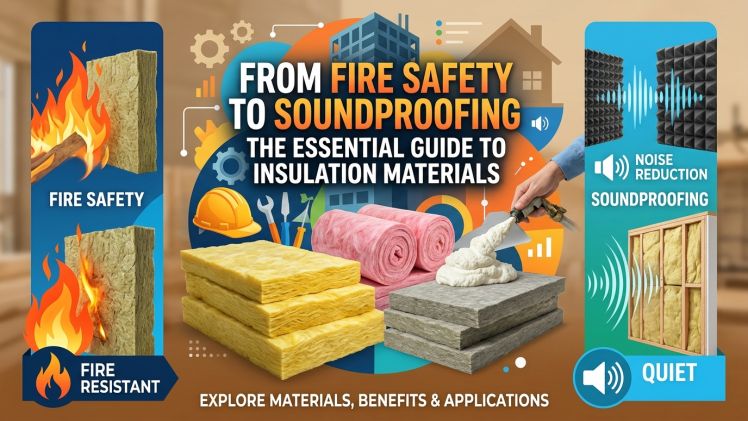
Insulation is often chosen for its ability to keep a building warm in winter and cool in summer, but its role extends far beyond temperature control. The right insulation material can improve fire safety, reduce noise transfer between rooms, support energy efficiency, and contribute to a more comfortable indoor environment. Choosing wisely requires understanding how materials behave in heat, how they perform acoustically, and how they must be installed to meet safety requirements.
Why Insulation Matters
Insulation works by slowing the movement of heat, sound, air, and sometimes moisture through walls, ceilings, floors, and roofs. In a well-designed building, it helps maintain stable indoor temperatures, reduces heating and cooling costs, and makes rooms quieter by limiting sound transmission. It can also fill concealed cavities that might otherwise allow fire, smoke, or noise to travel through a structure.
However, insulation is not a one-size-fits-all product. A material that performs well for thermal comfort may not be the best choice for a fire-rated wall, while another may absorb sound effectively but require a protective covering to meet fire-safety rules. This is why homeowners, builders, and renovators should assess fire performance, acoustic needs, moisture exposure, cost, and installation requirements together rather than relying on R-value alone.
Fire Safety Comes First
Fire safety should be one of the first considerations when selecting insulation, especially for walls near kitchens, garages, electrical panels, heating equipment, or shared walls between living spaces. Insulation materials differ significantly in how they react to fire: some are inherently non-combustible, while others can ignite or contribute to flame spread unless they are protected by approved finishes and barriers.
Unfaced fiberglass and mineral wool are generally considered non-combustible because their primary components glass, rock, or slag are minerals that do not burn. These materials can help fill voids and concealed spaces, limiting the movement of fire and smoke through a building when properly incorporated into an approved assembly.
Mineral Wool for Protection
Mineral wool, also called stone wool or rock wool, is one of the strongest choices when fire resistance and sound control are both priorities. Made from spun mineral fibers, it is naturally non-combustible and can withstand very high temperatures, with many products rated to endure temperatures around 1,000°C or 1,832°F.
Because mineral wool is denser than many other insulation options, it is particularly useful in party walls, home theaters, bedrooms, offices, and spaces where reducing sound transfer matters. Its density helps absorb sound energy within a wall cavity, while its fire-resistant nature makes it suitable for assemblies where safety is a major concern.
Fiberglass for Everyday Use
Fiberglass insulation remains one of the most widely used materials because it is affordable, lightweight, and easy to install in attics, wall cavities, and floors. Like mineral wool, unfaced fiberglass is classified as non-combustible, since it is made primarily from glass fibers rather than combustible organic material.
Fiberglass can provide useful sound absorption, especially when installed in interior partitions, ceilings, and floors. It is generally less dense than mineral wool, so it may not deliver the same level of acoustic performance in every situation, but it remains an effective and economical choice for many residential projects.
Foam Insulation Requires Barriers
Spray foam and rigid foam board insulation are valued for their excellent air-sealing ability and high thermal resistance. They can reduce drafts, improve energy efficiency, and help create a more airtight building envelope, which is especially useful in modern construction.
However, foam-based insulation is combustible and behaves differently from mineral-based products in a fire. Spray foam insulation can ignite at around 700°F, which is why it must be covered with an approved thermal barrier, such as gypsum board, in most occupied interior spaces.
Soundproofing With Insulation
Soundproofing is another major reason to invest in quality insulation. Noise travels through air gaps, vibrating walls, floors, ceilings, and structural connections, so insulation alone cannot make a room completely silent. Still, the right material can substantially reduce sound transfer when combined with proper construction techniques.
Fiberglass and mineral wool are especially effective at absorbing sound within wall and ceiling cavities. Mineral wool is often favored for acoustic projects because its higher density helps reduce vibration and sound transmission, while fiberglass offers a lower-cost alternative for general noise reduction.
Installation and Professional Advice
Even the best insulation can underperform if it is compressed, poorly fitted, left with gaps, or installed without required fire protection. Insulation should fill cavities evenly without being packed too tightly, since compression can reduce its effectiveness. Around wiring, pipes, vents, and electrical boxes, careful cutting and sealing help maintain both thermal and acoustic performance.
For fire-rated assemblies, the entire system matters not just the insulation. Wall framing, gypsum board thickness, fasteners, sealants, and insulation type must match the tested assembly specified by the manufacturer or local code. A fire-rated wall should be built exactly as specified, because changing one component can affect its certified performance.
Conclusion
Insulation is much more than a tool for reducing energy bills. It plays an essential role in fire safety, sound control, comfort, and the overall performance of a building. Mineral wool stands out for projects where fire resistance and noise reduction are priorities, while fiberglass offers a reliable and economical option for many everyday applications. Foam insulation can deliver strong thermal benefits but must always be protected with approved fire barriers.